Advanced Tool Filtering for Tool Selection
Issue: #1002
Current
Currently tool selection only uses embedding similarity, similarity threshold, and top-k. When embeddings are similar but intent is inconsistent, tools from incorrect domains may be selected.
#1002 proposes the need to introduce advanced tool filtering capabilities to reduce these misselections through sophisticated relevance filtering, while maintaining default behavior unchanged.
Solution
After embedding candidate set retrieval, add an optional advanced filtering stage. This stage applies deterministic filtering (allow/block lists, optional category gating, lexical overlap thresholds) and a combined score reranker that fuses embedding similarity with lexical, tag, name, and category signals. If advanced_filtering.enabled=false, existing behavior remains unchanged.
Solution advantages: maintains controllable latency, introduces no new model dependencies, and is fully explainable through configuration.
Comparative Test Results
Test configuration:
- Query set: 20 queries (17 positive examples, 3 negative examples), covering weather, email, search, calculation, calendar, and other scenarios
- Tool library: 5 tools (get_weather, search_web, calculate, send_email, create_calendar_event)
- Iterations: 10
- Advanced filtering configuration:
min_lexical_overlap=1,min_combined_score=0.35,weights={embed:0.7, lexical:0.2, tag:0.05, name:0.05}
Evaluation results:
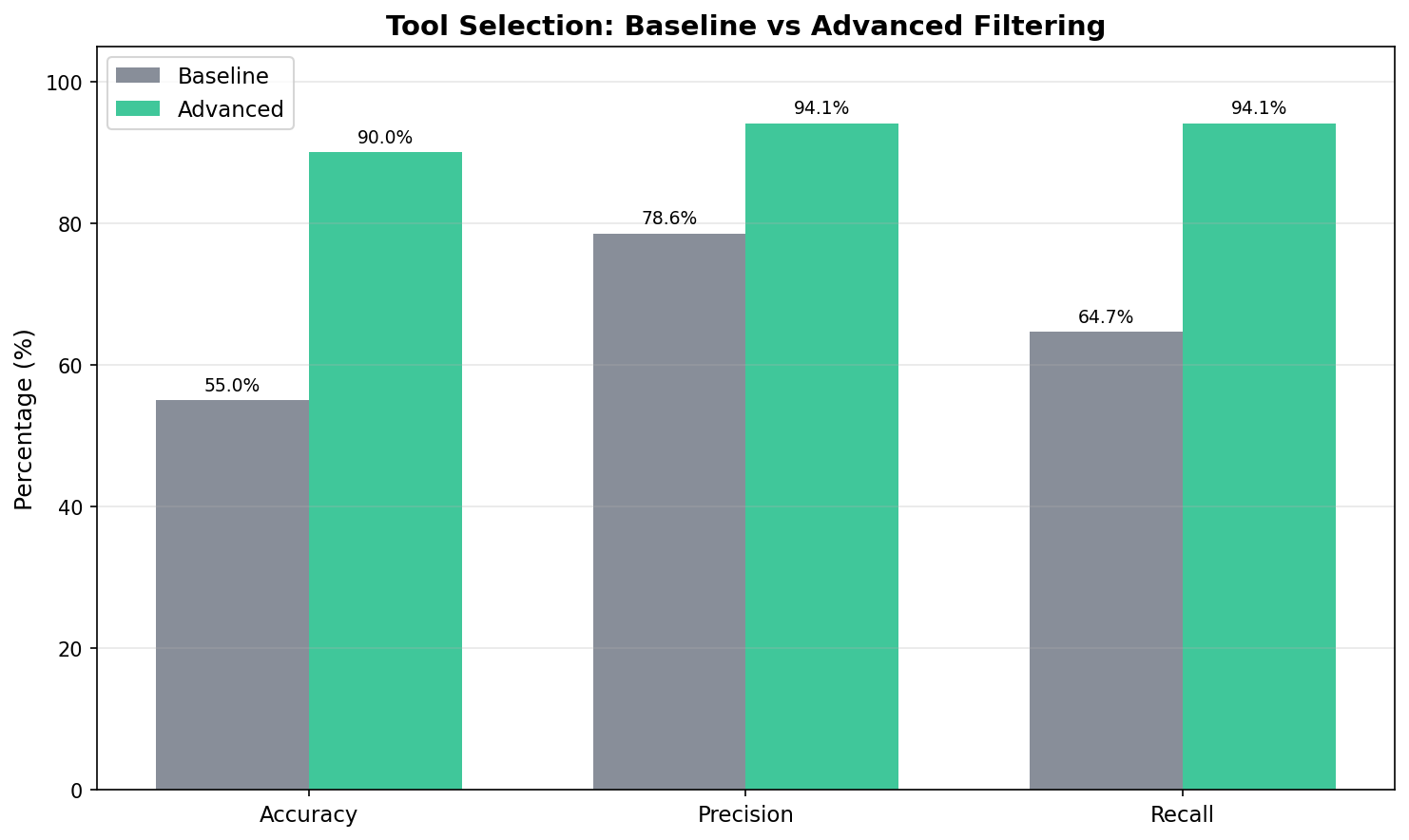
| Metric | Baseline | Advanced | Delta |
|---|---|---|---|
| Accuracy | 55.00% | 90.00% | +35.00% |
| Precision | 78.57% | 94.12% | +15.55% |
| Recall | 64.71% | 94.12% | +29.41% |
| False Positive Rate | 100.00% | 33.33% | -66.67% |
| Avg Latency | 0.0162 ms | 0.0197 ms | +0.0036 ms |
| P95 Latency | 0.0256 ms | 0.0288 ms | +0.0032 ms |
Data Flow
Configuration Changes
Advanced filtering is disabled by default. When enabled, the following fields take effect.
| Field | Type | Default | Range / Description |
|---|---|---|---|
enabled | bool | false | Enable advanced filtering. |
candidate_pool_size | int | max(top_k*5, 20) | If set and >0, use directly. |
min_lexical_overlap | int | 0 | Minimum unique token overlap between query and tool vocabulary. |
min_combined_score | float | 0.0 | Combined score threshold, range [0.0, 1.0]. |
weights.embed | float | 1.0 | If no weights are set, embed defaults to 1.0. |
weights.lexical | float | 0.0 | Optional weight, range [0.0, 1.0]. |
weights.tag | float | 0.0 | Optional weight, range [0.0, 1.0]. |
weights.name | float | 0.0 | Optional weight, range [0.0, 1.0]. |
weights.category | float | 0.0 | Optional weight, range [0.0, 1.0]. |
use_category_filter | bool | false | If true, filter by category when confidence is sufficient. |
category_confidence_threshold | float | nil | If set, category filtering only applies when decision confidence ≥ threshold. |
allow_tools | []string | [] | Tool name whitelist; when non-empty, only these tools are retained. |
block_tools | []string | [] | Tool name blacklist. |
Scoring and Filtering Implementation
Tokenization
Tokenization rules: convert to lowercase and split at non-alphanumeric characters. Only Unicode letters and numbers are counted as tokens. Implementation: src/semantic-router/pkg/tools/relevance.go#L240.
Lexical Overlap
Lexical overlap counts the intersection of the following unique tokens:
- Tool name
- Tool description
- Tool category
Tags are not included. Tags are a separate signal.
Combined Score Formula
For each candidate tool:
combined = (w_embed * embed + w_lexical * lexical + w_tag * tag + w_name * name + w_category * category) / (w_embed + w_lexical + w_tag + w_name + w_category)
embedis the similarity score, clamped to [0,1].lexicalandtagare overlap scores, normalized by query token count / tag token count.nameandcategoryare binary scores (0 or 1).- If no weights are set, embed defaults to 1.0.
- If all weights are explicitly set to 0, the combined score is 0; when
min_combined_score > 0, all candidates will be filtered.
Category Confidence Gating
Category filtering only takes effect when all of the following conditions are met:
use_category_filteris true,- A category exists, and
- Decision confidence ≥
category_confidence_threshold(if set).
Error Handling and Fallback
- When tool selection fails and
tools.fallback_to_empty=true: the request continues with no tools and a warning is logged. - If
fallback_to_empty=false: the request returns a classification error. - Invalid advanced configuration values are rejected during configuration loading (range validation in
validator.go).
API Changes
New or modified APIs and signatures:
// src/semantic-router/pkg/tools/tools.go
func (db *ToolsDatabase) FindSimilarToolsWithScores(query string, topK int) ([]ToolSimilarity, error)

// src/semantic-router/pkg/tools/relevance.go
func FilterAndRankTools(query string, candidates []ToolSimilarity, topK int, advanced *config.AdvancedToolFilteringConfig, selectedCategory string) []openai.ChatCompletionToolParam